‘Ornamental fish’ as the meaning denotes, are showpieces kept at homes.
They also come under the broader category of ‘pets’.
Though the term ‘aquarium pets’ is the term used to denote these small pets kept at home; nowadays it is being replaced by the term ‘ornamental fish’.
All small water living animals of class Pisces (fish) which are kept as pets and as decorative pieces can be called ornamental fish.
However the rarity of these small fish, their and manageability makes them more preferable for being kept as pets. Colours, shapes and variety of these small fish are predominant.

585616148
Some Species of Ornamental Fish:
1. Goldfish-
The goldfish (Carassius auratus) is a freshwater fish in the family Cyprinidae of order Cypriniformes. It is one of the most commonly kept aquarium fish.
A relatively small member of the carp family (which also includes the Prussian carp and the crucian carp), the goldfish is native to East Asia. It was first selectively bred in Ancient China more than a thousand years ago, and several distinct breeds have since been developed. Goldfish breeds vary greatly in size, body shape, fin configuration and colouration (various combinations of white, yellow, orange, red, brown, and black are known).
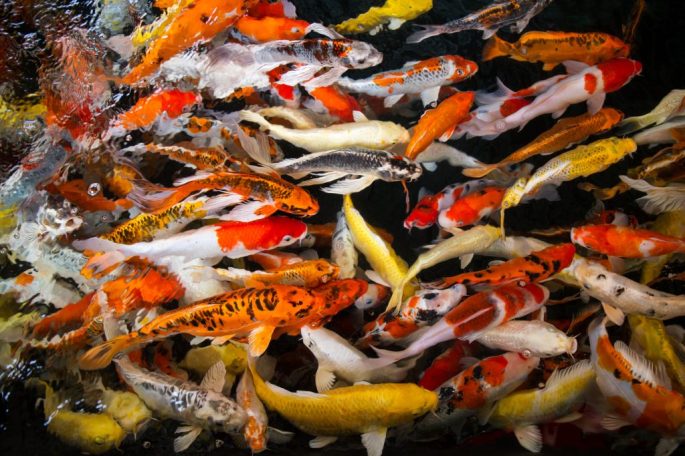
2. Koi
Koi is an informal group of the colored variants of the Cyprinus carpio. Several varieties are recognized by the Japanese. Koi varieties are distinguished by coloration, patterning, and scalation. Some of the major colors are white, black, red, orange, yellow, blue, and cream. The most popular category of koi is the Gosanke, which is made up of the Kohaku, Taisho Sanshoku, and Showa Sanshoku varieties.
3.Betta Fish
is a popular fish in the aquarium trade. Bettas are a member of the gourami family and are known to be highly territorial. Males in particular are prone to high levels of aggression and will attack each other if housed in the same tank. If there is no means of escape, this will usually result in the death of one or both of the fish. Female bettas can also become territorial towards each other if they are housed in too small an aquarium. It is typically not recommended to keep male and female bettas together, except temporarily for breeding purposes which should always be undertaken with caution.
4. Mollies
is a species of fish, of the genus Poecilia, known under the common name molly; to distinguish it from its congeners, it is sometimes called short-finned molly or common molly. They inhabit fresh water streams and coastal brackish and marine waters of Mexico. The wild-type fishes are dull, silvery in color. The molly can produce fertile hybrids with many Poecilia species, most importantly the sailfin molly. The male mollies generally tend to be mildly aggressive.
5. Guppies
The guppy (Poecilia reticulata), also known as million fish and rainbow fish, is one of the world’s most widely distributed tropical fish, and one of the most popular freshwater aquarium fish species. It is a member of the family Poeciliidae and, like almost all American members of the family, is live-bearing. Guppies, whose natural range is in northeast South America, were introduced to many habitats and are now found all over the world. They are highly adaptable and thrive in many different environmental and ecological conditions. Male guppies, which are smaller than females, have ornamental caudal and dorsal fins. Wild guppies generally feed on a variety of food sources, including benthic algae and aquatic insect larvae. Guppies are used as a model organism in the fields of ecology, evolution, and behavioral studies.
6. Flowerhorn
are ornamental aquarium fish noted for their vivid colors and the distinctively shaped heads for which they are named. Their head protuberance, or kok, is formally termed a “nuchal hump.” Like blood parrot cichlids, they are man-made hybrids that exist in the wild only because of their release. First developed in Malaysia, Thailand, and Taiwan, they became very popular with Asian fish hobbyists. They are also kept by hobbyists in the US and Europe, but their importation is banned in Australia. Some cichlid hobbyists have questioned the impact of flowerhorn breeding programs and their impact on the health and reproduction of the animals, and on natural fish species.
7. Arowana
Arowanas are freshwater bony fish of the family Osteoglossidae, also known as bonytongues (the latter name is now often reserved for Arapaimidae).In this family of fish, the head is bony and the elongated body is covered by large, heavy scales, with a mosaic pattern of canals. The dorsal and anal fins have soft rays and are long based, while the pectoral and ventral fins are small. The name “bonytongues” is derived from a toothed bone on the floor of the mouth, the “tongue”, equipped with teeth that bite against teeth on the roof of the mouth. The arowana is a facultative air breather and can obtain oxygen from air by sucking it into its swim bladder, which is lined with capillaries like lung tissue.



 Delicana`s Fish